donderdag 15 augustus 2013

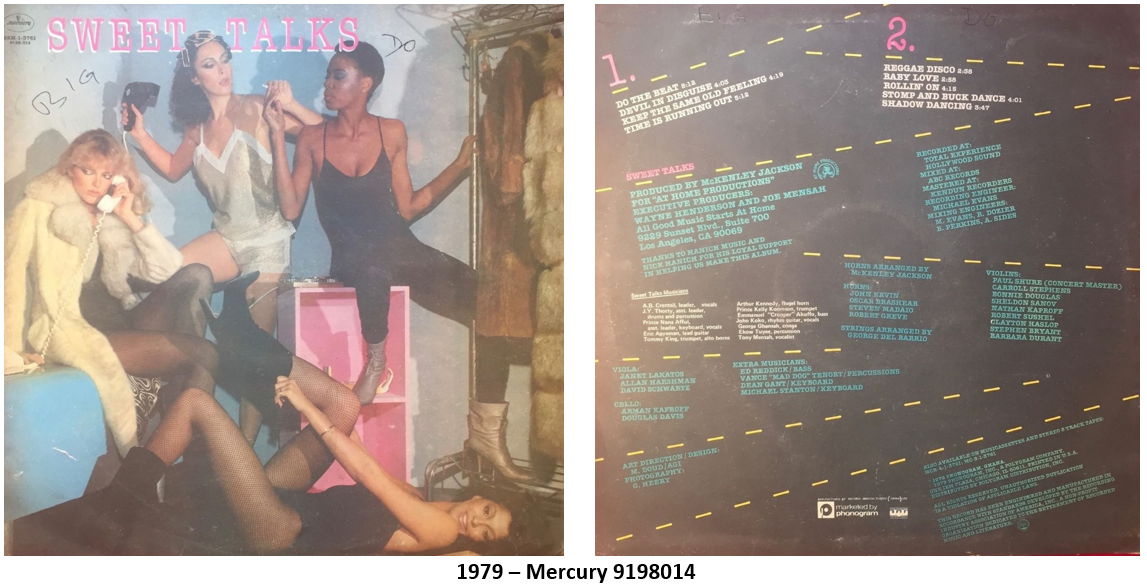
A.B. Crentsil & (Super) Sweet Talks (International)


Biography


From left to right: Tommy King, Nana Afful, Cropper (sitting), Arthur Kennedy, George Quansah,
Eric Agyeman, JW Thorty, AB Crentsil, John Koko, Ekow Tuyee, Kelly Koomson, Tony Mensah. 
 The Sweet Talks were more than just a band, they were an institution, a training-ground for Ghanaian highlifers. The name has been imitated, taken in vain, stolen; there have been Sweet Beans and Talkative Sweets, but there was only one - or at the most, two - Sweet Talks.
 
The band was formed in late 1973, and shortly afterwards took up an extended residency at the Talk Of The Town Hotel in Tema. The key founder members were Pope Flynn and A.B.Crentsil (vocals) and Smart Nkansah (guitar). In the next few years, other major talents would join, including vocalist Jewel Ackah and guitarist Eric Agyeman. The band's early music had two distinct styles. One was a throwback to colonial days, with the band playing cover versions of European and North American chart hits, sung by Flynn. The other was Ghanaian cultural music, sung by Crentsil in a uniquely husky, red-blooded voice.
Born in the Western region, Crentsil had spent his early years listening to such roots styles as osode and palm wine. He worked as a railwayman, singing part-time with local bands such as the Eldoradoes and the Medican Lantics. He first met Nkansah when the latter was touring with Yamoah's Guitar Band in 1972; the two became friends and, recruiting Flynn, decided to form the Sweet Talks.

The group's first hit was the single "Adam And Eve" in 1975, which was followed by the successful album The Kusum Beat in 1976, an update of northern Ghanaian traditional music based around percussion and xylophones. In 1977, the band repeated this success with Spiritual Ghana, this time based on osode highlife rhythms. In 1979, when the band were about to set off on a tour of the USA, Nkansah left, to be replaced by another of Ghana's leading roots guitarists, Eric Agyeman, previously a member of Dr. K. Gyasi's Noble Kings. He had started his career in 1963, playing Beatles and Rolling Stones covers in Afro Boateng's Midnight Movers, and had joined Gyasi in 1972, combining the roles of lead guitarist and arranger.

The new Sweet Talks line-up spent autumn 1979 in the USA, recording Hollywood Highlife Party with Wayne Henderson of the Crusaders (for whom they also recorded album backing tracks) and Sweet Talks. Deeply unhappy with the Californian winter, they then returned to Ghana, where they had a dispute with their manager and disbanded. Agyeman and Crentsil formed Super Brain, which lasted only a short time. Agyeman then returned to Gyasi and later went solo.

 
Crentsil picked up the pieces with a new line-up, Super Sweet Talks International, and released The Lord's Prayer, which included "Area Special", a hymn of praise to palm wine drinking. He then took the band to the Ivory Coast, where they recorded Tantie Alaba, which included another drinking classic in "Akpetchi Seller" (akpetchi being a form of Ghanaian gin).
 
 In 1984, Crentsil moved temporarily to the UK, where - together with Agyeman, also visiting - he fronted a band put together by Mac Tontoh of Osibisa, which recorded Highlife Stars, released on Osibisa's own Flying Elephant label. Tontoh, Crentsil and Agyeman had hoped that Highlife Stars - also the name of the band which recorded it and gigged behind it - would make a major impact in the UK, then in the throes of a substantial explosion of interest in African music. But while the album made a huge impact on specialist audiences it failed to make any mainstream impression.

Crentsil and Agyeman accordingly returned to Ghana towards the end of 1984, Crentsil to form Ahenfo and Agyeman to form Kokroko. By this time, Ackah had formed a second, short-lived incarnation of the Sweet Talks, based in the Ivory Coast. The most successful ex-original Sweet Talks member was Nkansah who, following his departure from the band in 1979, formed the popular, highlife-based Sunsum Band, and enjoyed two top-selling albums with Disco Spiritual (1981) and the rootsier Odo (1985).

Since Günther Gretz of the Popular African Music label released Hollywood Highlife Party on CD in 1991, several of the (Super) Sweet Talks albums have been re-released. However, this does not apply to the four 'LPs that Crentsil made between 1979 and 1983,under the name "Super Sweet Talks International." You can hear below that these albums also contain irrisistible danceable Highlife. Enjoy yourself !!!


Discography


Line up (Super) Sweet Talks (International)

AB Crentsil - Lead Vocals (ST/SST/SSTI)
Smart Nkansah - Guitar, Vocals (ST)
Nana Afful - Organ, Synth, Vocals (ST)
Arthur Kennedy - Flugelhorn, Trumpet, (ST/SSTI)
JY Thorty - Drums, Percussion, Vocals (ST/SST)
Nat Arthur - (ST)
RS (pope) Flynn - Percussion, Vocals (ST)
Cropper - Rhythm & Bass Guitar (ST/SSTI)
Max Cozy - Keyboard, Violin, Percussion, (ST)
Tommy King - Trumpet (ST)
Asei Akoto - (ST)
Yaw Samuel - Conga (ST)
Eric Agyeman - Lead Guitar (ST)
Prince Kelly Komsoor - Trumpet (ST/SST/SSTI)
John Koko - Rhtthm Guitar, Vocals (ST)
George Quansah - Conga (ST)
Ekow Tuyee - Percussion (ST/SST/SSTI)
Tony Mensah - Lead Vocals (ST/SST)
Solo Mensah - Lead Guitar (SST/SSTI)
Tommy Sly Ampah - Bass Guitar (SST/SSTI)
Prince Foster - Organ (SST/SSTI)
Tex Korley - Alt & Tenorsax (SST/SSTI)
Lord Sekyi - (SST/SSTI)
Gibson Peprah - Drums (SSTI)
Evans Donkor (SSTI)
Uncle Brown (SSTI)


donderdag 25 oktober 2012

Eduardo Paim

His new CD entitled "Etu Mu Dietu"
The Angolan musician Eduardo Paim, returned to the record market with a CD entitled "Etu Mu Dietu" ("Between Us" in the Kimbindu language). The album contains 13 songs in the Angolan Semba & Kizomba musical styles.


Eduardo Paim & Jacob Desvarieux (Kassav) 


♫  clip:   Etu mu dietu  2012
 
The album, which was launched last August in Lisbon (Portugal), counted on the participation of international stars as Kassav's Jacob Desvarieux, the Congolese star Papa Wemba, Cape Verdean musican Grace Evora, as well as Angolan Kuduristas Zoca Zoca and Agre G. Produced and directed by Eduardo Paim himself, "Etu mu dietu" is the result from the work of about a year and a half, which began in Namibia, through Luanda, Lisbon and Paris.
 
A short biography
Eduardo Paim was born in Congo Brazzaville, 47 years ago, where his parents had been exiled. As student he started  singing in 1979 with the group "Os Puros" together with Levi and Bruno Lara Marcellin. In 1982 Eduardo Paim founded a new band 'SOS', which became quite popular in Angola during the mid-eighties After he finished the course average electricity at Makarenko, Eduardo Paim devoted himself entirely to music.
In 1988 Eduardo Paim took a new step in the development of his musical career when he decided to leave Angola and to move to Portugal. In 1991 he made a successful debut with the album  "Luanda minha banda". 

♫ audio: 1991 Som Da Banda  

His real breakthrough, however, he reached in 1992 with his second record "Do kaiaia". The singer received his first golden disk for sales exceeding 50.000 copies. 

♫ audio: 1992 Sao Saudades 

He continued his success with the albums "Kambuengo" (1994) which contained the  popular song "Rosa baila", "Chindu a tempo" (1995) and "Ka-Ne-La" (1996). 
♫ Clip:  Rosa Baila - 1994

Eduardo Paim & Paulo Flores


An accusation of involvement with drugs almost broke his career in 1997. From doing six shows a month his schedule was reduced to one per year. He decided to return to Angola in order to realise an old dream; building up his own record studio. With this new project  the "EP Studios" he soon earned a big name in the Angolan music business as producer. In this new role he supported the career of many Angolan singers and groups of the new generation such as Paulo Flores, Dog Murras and Banda Maravilha.
This focus on his producing activities reduced his own cd-output, so after the release of the cd "Mujimbus" (1998) his fans had to wait nearly eight years for a sucessor.

In fact the album "Maruva na taca" (2006) meant a real "come-back" of "General Kambuengo". With the participation of artists such as Bonga, Papytchulo, Nancy Vieira, Big Boss and Yuri da Cunha among many others, Paim gathered an impressive list of guest musicians on this album. After "Maruva na taca"  Eduardo Paim took again a long period before he came with his new cd "Etu mu dietu".  

 
His albums are available at: $: AMAZON
 
DISCOGRAPHY


zondag 24 juni 2012

Ernesto Djédjé (1948–1983)


Early years 1947 - 1968

Ernest Djédjé Blé Loué was born in 1947 in Béte country Ivory Coast in the village Tahiraguhé near the town Daloa. Djédjé's father was a Senegalese Wolof man, but his mother came from the Bété people who surrounded him in his village Daloa.


Together with his friend Mamadou Kante, Ernesto Djédjé founded in 1963 his first band called 'The Antelopes'. The band gave concerts in Dalao and throughout the western Ivory Coast. In 1965 Amédée Pierre recognized the talent of Mamadou and Ernesto and recruited the two teenagers in his band 'Ivoiro Star', the leading Dopé band of the time. Mamadou became bass player and Ernesto guitarist. From 1965 to 1968 Ernesto  Djédjé was also the conductor of the Ivoiro Star Band.

Paris 1968 - 1973
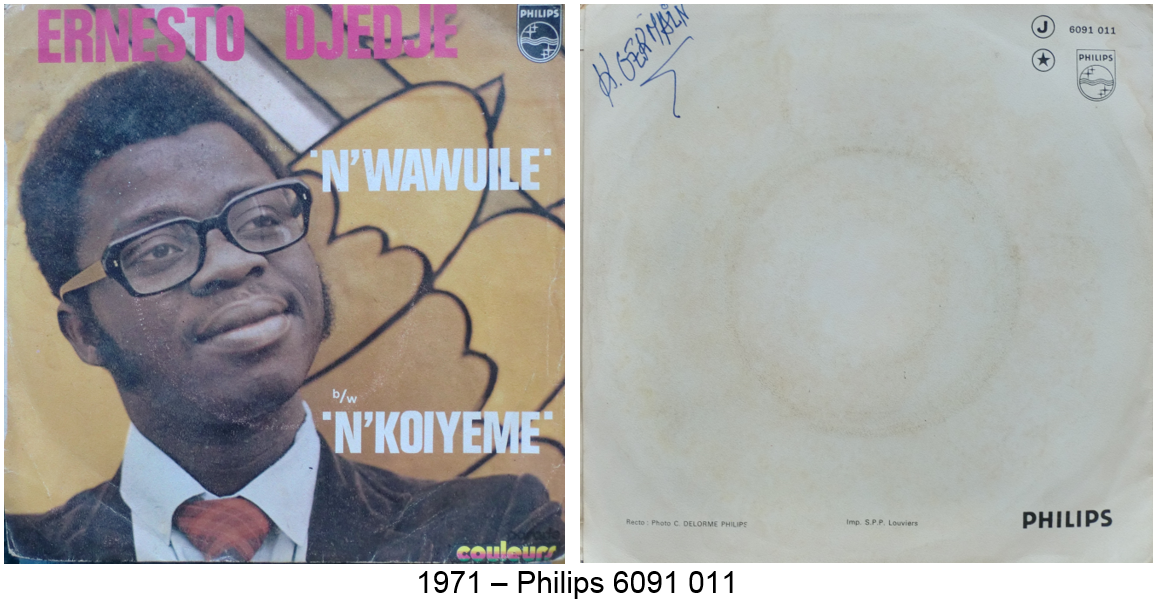
In 1968 he decides to emigrate to Paris to study computer science. He became one of the few immigrants in France in the 1960's. In France he met several African music celebrities such as Manu Dibango, Anouma Brou Felix and Francis Lougah. With their cooperation, inculding that of Manu Dibango, he recorded his first record entitled Anowa in 1970. it was a 45prm single, strongly influenced by American Soul and Rhythm & Blues. Another 45rpm single, Gniah-Pagnou followed within a year. In 1971 he released two more 45rpm singles N'wawuile and Lourognon gbla with 'l'Orchestre Reeba'. After this four records, released on the Philips record label, he records two more 45rpm singles in 1973, Mahoro and Zokou gbeuly  on the Fiesta record label. Shortly after he decides to return to Ivory Coast.

A period of musical research 1973 - 1976
Back in Ivory Coast Ernest begins his efforts to modernize the Ivorian music. He wants to revolutionize the Ivorian music by mixing elemets of Western Disco, Funk, Cuban Rumba and Central African pop music like Makossa with traditional Ivorian music. When travelling to Nigeria, he discovers the Afrobeat of Fela Anikulapo Kuti, a mix of tradional Yoruba Rhythms, Funk, Jazz and Highlife. A musical style that sticks to his desires. Finally he feels capable to combine dance and disco Bété, with lyrical songs 'Tohourou', Rhythm & Blues and his own  locally-based guitar style.  In this period he released Aguisse, on the record label of Gbadamassi Raimi, aka Badmos. He calls the result of his experiments 'Ziglibithy', the music which soon will bring him fame in Ivory Coast and later throughout West Africa.


The National Gnoantré  1977 - 1983

During 1977 he spent six months in Lagos, Nigeria to record his first LP Ziboté  in cooperation with Badmos, founder of Badmos Store and the Maikana record label. The album became an instant hit in Ivory Coast and the rest of West Africa. Djedjé was devoted 'best musician of the year'  and his band which consisted of Diabo Steck, Bamba Yang, Lén Sina, Eugène Gba, Yodé, Tagus, Assalé Best and Abu Yubla, became famous by their exciting stage performances. With his second LP Ziglibithiens, which came out in 1978, Djedjé reached the top of his fame. He is discribed as 'Gnoantré National', the man with whom a nation fight, because 'Gnoantré' means struggle/fight in the Béte language. Filosophy professor Yacouba Konaté said the following about Ernesto Djedjé and his Ziglibithy music: "Better than any theory of authenticity, better than any speech advocating a return to sources, Ziglibithy gives meaning and shape to the will of Africans who want to feed on the sap of their roots. It's an action, a recreation that a new aesthetic based on the cultural and historical base of Ivorian society". He becomes the icon of a generation in search of a new identity, modernizing culture of Western influence while tapping into Ivorian culture.


Ziglibithiens is followed by the albums Golozo (1979, Azonadé in (1980)  and Zouzoupalé (1981).  and Tizéré (1982). The artist finished his career with the album Tizeré including a song in tribute to the politician Konan Bedie in 1982 and another, dedicated to President Felix Houphouet-Boigny Houphouët-Boigny called Zeguehi. At that time Ernesto Djedje - close to the single ruling party, the PDCI-RDA - was the "darling" of President Felix Houphouet-Boigny and Bédié. No conference or reception of presidential importance was organized without a performance of "national Gnoantré". He was often invited to perform with the orchestra of the Ivorian Radio and Television. He then made the heyday of Radio Côte d'Ivoire, including after his sudden death in June 1983 in Yamoussoukro.

Death: mysterious disappearance

Ernesto Djedje died suddenly June 9, 1983 at the military hospital in Yamoussoukro at the age of 35 years. His death constituted a shock to the Ivorian nation. Officially, the artist died subsequent to poisoning after his return travel from Ouagadougou in Burkina Faso during a meal at Yamoussoukro. To date, no survey result is available. Several assumptions and rumors circulated about his death, rumors by the press obligingly ivoirienne On July 30, 1983 his body was displayed at the Stade de Tahiraguhé. His funeral will take several days with the delivery of several artists including  Alpha Blondy.
(Main resource: Wikipedia)

Discography


maandag 28 mei 2012

Freddy Mayaula Mayoni 1946 - 2010


Biography

Born in Léopoldville (now Kinshasa) on the sixth of November 1946, Mayaula passes effortlessly through primary school. In 1962 he completed secondary education at the College of Kisantu. The young Mayaula appears to be a passionate and good football player. Between 1968 and 1971 he plays at a high level as a left winger in the first team of 'AS Vita Club' in Kinshasa. In this period he is also selected for the national team of Zaire.


When his father is stationed as a diplomat in Dar es Salam, Mayaula follows his father to Tanzania and plays some time with 'Yanga Sports'. Then he leaves for Charleroi in Belgium where he follows a course in data processing. In Belgium his talent is also noticed and he plays professional soccer with 'Racing Club de Charleroi' and 'Racing Club de Jette'in Brussels. He also plays for some time in Switzerland with 'FC. Fribourg'. In this period he gets acquainted with the guitar through a study friend. Also musically he shows himself a talented student and soon he joins the Congolese student orchestra 'Africana' as rhythm guitarist.
When he returns to Kinshasa, Mayaula makes a career switch from professional soccer player to professional composer and musician. Back home he immediately draws the attention of his former football president and band leader Franco, who asks Mayaula to join his band and adds his song 'Cherie Bonduwe' to the repertoire of his TPOK Jazz.


The melodic and thematically rich song receives much attention, not in the least because the National Censorship Commission prohibits the song. Cherie Bondowe presented the life of a prostitute from her point of view and is considered by the authorities as a defense of prostitution. The song was first released in Brussels, and rapidly found its way back to Kinshasa, despite the ban by the government.
Although Franco requested him to join TPOK Jazz, Mayaula Mayoni has never been an official band member of the TPOK Jazz. "He was something of an independent oddity in the music business" writes Gary Stewart in 'Rumba on the river'. "He prefered to compose his songs and then offer them to whichever artist he felt they fit. Many of his memorable efforts like 'Nabali misère' and 'Momi' found their way to OK Jazz".
( Gary Stewart: Rumba on the river page 222)


In 1977 it was female singer Mpongo Love who scored with Mayaula's composition 'Nadaya' a song that tells the story of a woman happy in her marriage and confident of keeping her husband, despite the overtures of other women.


Many people mistakenly think that Mayaula was not only a gifted guitarist and composer, but a good singer as well. Although he sometimes acted as background vocalist during recordings and live performances, he has never presented himself as a lead singer. Probably this misconception is caused by a picture on the cover of the album 'Veniuza', on which we find Mayaula behind the microphone.

In 1981 Mayaula leaves Zaire together with some musicians from female singer Abeti's band Les Redoutables, to try his luck in West-Africa. In the period between 1981 and 1984 he records several solo LP's in Lomé (Togo) for the record label Disc-Oriënt'. In 1984 he returns to Zaire where he releases the album 'Fiona fiona' in 1986. In the same year female singer Tshala Muana gains success with 'Nasi nabali', a composition written by Mayaula Mayoni. He records his next album 'Mizélé' with the help of musicians of TPOK Jazz and singers Carlito Lassa and Malage de Lugendo.


In 1993 he hits the charts again with the album 'L'amour au kilo'. It then lasts until 2000, before he comes with a new album 'Bikini'. Not long after the release of this album, Mayaula settles again in Dar es Salam, where he accepts a job at the diplomatic service. In the years that followed he began to suffer increasingly the consequences of hemiplegia, a disease that may result in loss of speech and paralysis of linmbs. In 2005 he returns to his place of birth Makadi. As his condition continues to deteriorate his family decides in cooperation with the authorities to bring Mayaula to Brussels for medical treatment. After a long illness of several month's he dies in Brussels on May 26, 2010 at the age of 64 years. During his impressive career, Mayaula Mayoni was repeatedly voted 'composer of the year'in Zaire. In 1978 for the song 'Bonduwe II', in 1979 for 'Nabali misère' and in 1993 for the song 'Ousmane Bakayoko'.

Links:


Discography: