zondag 16 oktober 2016

K.Frimpong

Kwasi Frimpong (Kumasi 1939) started his musical career in the ‘50s as lead vocalist with the Axim Jokers. In 1963 he joined Dr. Gyasi’s Noble Kings as solo guitarist. Six years later he formed his own band, The Cubano Fiestas. In 1975 he released his first album Ahyewa backed by the Super Complex Sounds.
The succes came in 1976 with his second album. This so called ‘blue’ album known as Kyen yen bi adi mawu became one of the biggest hits of the decade in Ghana.

He repeated this success in 1977 with his third album Hwehwe mu na yi wo mpena.

In 1978 he recorded Aboagyewaa, an album that is today one of the most sought after collectors items, when it comes to African music.
During the ‘80s the music culture of Ghana collapsed completely due tot the military coup led by Jerry Rawlings in 1979. As a result of the anti-corruption “house-cleaning” policy of the military gouvernment and very strict curfews, many local record stores, bars and venues closed. Many ghanian musicians left Ghana for Europe and tried their luck in countries such as Holland, the UK and particulary Germany. After having rerecorded some of his greatest hits for Polydor in 1980, 
Frimpong left Ghana in 1981 as well to record his sixth album Abrabo in Hamburg, Germany.


During the following years his musical productivity gradually decreased. His fans had to wait four years until 1985 before he released the album Mo tan me.

In 1990 he recorded the album Rikia and although some fellow musicians in Germany were successful with their so called “Burger” Highlife, Frimpong could not bring back the glorious days of the ‘70s.

Five years later Frimpong released his first CD under the title Okwantuni. This album would prove to be his last album. Kwesi Frimpong died on October 18th 2005 in Kumasi. With his death Ghana lost one of his greatest musical legends.


In the beginning of the new millennium some dj’s rediscovered the almost forgotten ‘funky’ music scene that existed in many African countries during the 70’s. This interest brought us also a revival of Frimpongs music. In 2001 Kyenkyen bi adi m’awi appeared on the sampler Afro-Rock, followed by Hwehwe mu na yi wo mpena and Aboagyewaa on the two Ghana Soundz samplers in 2002 en 2004. The resurgence of vinyl brought us the reissue of the 'blue' and 'black' album in 2011 by Continental Records. Hopefully Continental Records will surprise us a third time with the reissue of the 'Red' album.


Discography

donderdag 15 augustus 2013

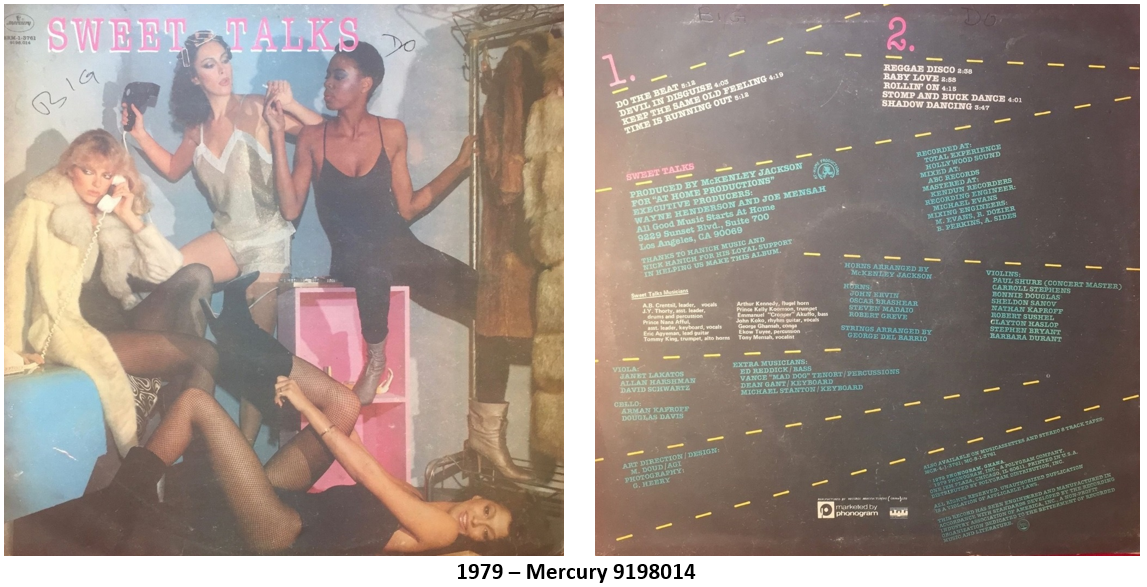
A.B. Crentsil & (Super) Sweet Talks (International)


Biography


From left to right: Tommy King, Nana Afful, Cropper (sitting), Arthur Kennedy, George Quansah,
Eric Agyeman, JW Thorty, AB Crentsil, John Koko, Ekow Tuyee, Kelly Koomson, Tony Mensah. 
 The Sweet Talks were more than just a band, they were an institution, a training-ground for Ghanaian highlifers. The name has been imitated, taken in vain, stolen; there have been Sweet Beans and Talkative Sweets, but there was only one - or at the most, two - Sweet Talks.
 
The band was formed in late 1973, and shortly afterwards took up an extended residency at the Talk Of The Town Hotel in Tema. The key founder members were Pope Flynn and A.B.Crentsil (vocals) and Smart Nkansah (guitar). In the next few years, other major talents would join, including vocalist Jewel Ackah and guitarist Eric Agyeman. The band's early music had two distinct styles. One was a throwback to colonial days, with the band playing cover versions of European and North American chart hits, sung by Flynn. The other was Ghanaian cultural music, sung by Crentsil in a uniquely husky, red-blooded voice.
Born in the Western region, Crentsil had spent his early years listening to such roots styles as osode and palm wine. He worked as a railwayman, singing part-time with local bands such as the Eldoradoes and the Medican Lantics. He first met Nkansah when the latter was touring with Yamoah's Guitar Band in 1972; the two became friends and, recruiting Flynn, decided to form the Sweet Talks.

The group's first hit was the single "Adam And Eve" in 1975, which was followed by the successful album The Kusum Beat in 1976, an update of northern Ghanaian traditional music based around percussion and xylophones. In 1977, the band repeated this success with Spiritual Ghana, this time based on osode highlife rhythms. In 1979, when the band were about to set off on a tour of the USA, Nkansah left, to be replaced by another of Ghana's leading roots guitarists, Eric Agyeman, previously a member of Dr. K. Gyasi's Noble Kings. He had started his career in 1963, playing Beatles and Rolling Stones covers in Afro Boateng's Midnight Movers, and had joined Gyasi in 1972, combining the roles of lead guitarist and arranger.

The new Sweet Talks line-up spent autumn 1979 in the USA, recording Hollywood Highlife Party with Wayne Henderson of the Crusaders (for whom they also recorded album backing tracks) and Sweet Talks. Deeply unhappy with the Californian winter, they then returned to Ghana, where they had a dispute with their manager and disbanded. Agyeman and Crentsil formed Super Brain, which lasted only a short time. Agyeman then returned to Gyasi and later went solo.

 
Crentsil picked up the pieces with a new line-up, Super Sweet Talks International, and released The Lord's Prayer, which included "Area Special", a hymn of praise to palm wine drinking. He then took the band to the Ivory Coast, where they recorded Tantie Alaba, which included another drinking classic in "Akpetchi Seller" (akpetchi being a form of Ghanaian gin).
 
 In 1984, Crentsil moved temporarily to the UK, where - together with Agyeman, also visiting - he fronted a band put together by Mac Tontoh of Osibisa, which recorded Highlife Stars, released on Osibisa's own Flying Elephant label. Tontoh, Crentsil and Agyeman had hoped that Highlife Stars - also the name of the band which recorded it and gigged behind it - would make a major impact in the UK, then in the throes of a substantial explosion of interest in African music. But while the album made a huge impact on specialist audiences it failed to make any mainstream impression.

Crentsil and Agyeman accordingly returned to Ghana towards the end of 1984, Crentsil to form Ahenfo and Agyeman to form Kokroko. By this time, Ackah had formed a second, short-lived incarnation of the Sweet Talks, based in the Ivory Coast. The most successful ex-original Sweet Talks member was Nkansah who, following his departure from the band in 1979, formed the popular, highlife-based Sunsum Band, and enjoyed two top-selling albums with Disco Spiritual (1981) and the rootsier Odo (1985).

Since Günther Gretz of the Popular African Music label released Hollywood Highlife Party on CD in 1991, several of the (Super) Sweet Talks albums have been re-released. However, this does not apply to the four 'LPs that Crentsil made between 1979 and 1983,under the name "Super Sweet Talks International." You can hear below that these albums also contain irrisistible danceable Highlife. Enjoy yourself !!!


Discography


Line up (Super) Sweet Talks (International)

AB Crentsil - Lead Vocals (ST/SST/SSTI)
Smart Nkansah - Guitar, Vocals (ST)
Nana Afful - Organ, Synth, Vocals (ST)
Arthur Kennedy - Flugelhorn, Trumpet, (ST/SSTI)
JY Thorty - Drums, Percussion, Vocals (ST/SST)
Nat Arthur - (ST)
RS (pope) Flynn - Percussion, Vocals (ST)
Cropper - Rhythm & Bass Guitar (ST/SSTI)
Max Cozy - Keyboard, Violin, Percussion, (ST)
Tommy King - Trumpet (ST)
Asei Akoto - (ST)
Yaw Samuel - Conga (ST)
Eric Agyeman - Lead Guitar (ST)
Prince Kelly Komsoor - Trumpet (ST/SST/SSTI)
John Koko - Rhtthm Guitar, Vocals (ST)
George Quansah - Conga (ST)
Ekow Tuyee - Percussion (ST/SST/SSTI)
Tony Mensah - Lead Vocals (ST/SST)
Solo Mensah - Lead Guitar (SST/SSTI)
Tommy Sly Ampah - Bass Guitar (SST/SSTI)
Prince Foster - Organ (SST/SSTI)
Tex Korley - Alt & Tenorsax (SST/SSTI)
Lord Sekyi - (SST/SSTI)
Gibson Peprah - Drums (SSTI)
Evans Donkor (SSTI)
Uncle Brown (SSTI)



donderdag 25 oktober 2012

Eduardo Paim

His new CD entitled "Etu Mu Dietu"
The Angolan musician Eduardo Paim, returned to the record market with a CD entitled "Etu Mu Dietu" ("Between Us" in the Kimbindu language). The album contains 13 songs in the Angolan Semba & Kizomba musical styles.


Eduardo Paim & Jacob Desvarieux (Kassav) 


  clip:   Etu mu dietu  2012
 
The album, which was launched last August in Lisbon (Portugal), counted on the participation of international stars as Kassav's Jacob Desvarieux, the Congolese star Papa Wemba, Cape Verdean musican Grace Evora, as well as Angolan Kuduristas Zoca Zoca and Agre G. Produced and directed by Eduardo Paim himself, "Etu mu dietu" is the result from the work of about a year and a half, which began in Namibia, through Luanda, Lisbon and Paris.
 
A short biography
Eduardo Paim was born in Congo Brazzaville, 47 years ago, where his parents had been exiled. As student he started  singing in 1979 with the group "Os Puros" together with Levi and Bruno Lara Marcellin. In 1982 Eduardo Paim founded a new band 'SOS', which became quite popular in Angola during the mid-eighties After he finished the course average electricity at Makarenko, Eduardo Paim devoted himself entirely to music.
In 1988 Eduardo Paim took a new step in the development of his musical career when he decided to leave Angola and to move to Portugal. In 1991 he made a successful debut with the album  "Luanda minha banda". 

audio: 1991 Som Da Banda  

His real breakthrough, however, he reached in 1992 with his second record "Do kaiaia". The singer received his first golden disk for sales exceeding 50.000 copies. 

audio: 1992 Sao Saudades 

He continued his success with the albums "Kambuengo" (1994) which contained the  popular song "Rosa baila", "Chindu a tempo" (1995) and "Ka-Ne-La" (1996). 
Clip:  Rosa Baila - 1994

Eduardo Paim & Paulo Flores


An accusation of involvement with drugs almost broke his career in 1997. From doing six shows a month his schedule was reduced to one per year. He decided to return to Angola in order to realise an old dream; building up his own record studio. With this new project  the "EP Studios" he soon earned a big name in the Angolan music business as producer. In this new role he supported the career of many Angolan singers and groups of the new generation such as Paulo Flores, Dog Murras and Banda Maravilha.
This focus on his producing activities reduced his own cd-output, so after the release of the cd "Mujimbus" (1998) his fans had to wait nearly eight years for a sucessor.

In fact the album "Maruva na taca" (2006) meant a real "come-back" of "General Kambuengo". With the participation of artists such as Bonga, Papytchulo, Nancy Vieira, Big Boss and Yuri da Cunha among many others, Paim gathered an impressive list of guest musicians on this album. After "Maruva na taca"  Eduardo Paim took again a long period before he came with his new cd "Etu mu dietu".  

 
His albums are available at: $: AMAZON
 
DISCOGRAPHY


zondag 24 juni 2012

Ernesto Djédjé (1948–1983)


Early years 1947 - 1968

Ernest Djédjé Blé Loué was born in 1947 in Béte country Ivory Coast in the village Tahiraguhé near the town Daloa. Djédjé's father was a Senegalese Wolof man, but his mother came from the Bété people who surrounded him in his village Daloa.


Together with his friend Mamadou Kante, Ernesto Djédjé founded in 1963 his first band called 'The Antelopes'. The band gave concerts in Dalao and throughout the western Ivory Coast. In 1965 Amédée Pierre recognized the talent of Mamadou and Ernesto and recruited the two teenagers in his band 'Ivoiro Star', the leading Dopé band of the time. Mamadou became bass player and Ernesto guitarist. From 1965 to 1968 Ernesto  Djédjé was also the conductor of the Ivoiro Star Band.

Paris 1968 - 1973
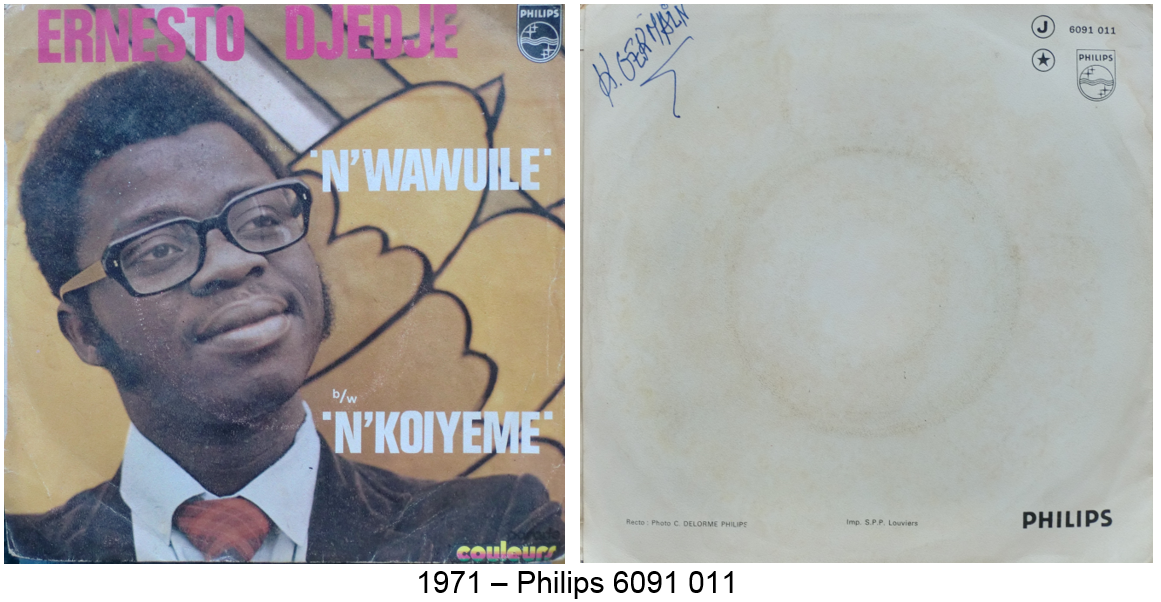
In 1968 he decides to emigrate to Paris to study computer science. He became one of the few immigrants in France in the 1960's. In France he met several African music celebrities such as Manu Dibango, Anouma Brou Felix and Francis Lougah. With their cooperation, inculding that of Manu Dibango, he recorded his first record entitled Anowa in 1970. it was a 45prm single, strongly influenced by American Soul and Rhythm & Blues. Another 45rpm single, Gniah-Pagnou followed within a year. In 1971 he released two more 45rpm singles N'wawuile and Lourognon gbla with 'l'Orchestre Reeba'. After this four records, released on the Philips record label, he records two more 45rpm singles in 1973, Mahoro and Zokou gbeuly  on the Fiesta record label. Shortly after he decides to return to Ivory Coast.

A period of musical research 1973 - 1976
Back in Ivory Coast Ernest begins his efforts to modernize the Ivorian music. He wants to revolutionize the Ivorian music by mixing elemets of Western Disco, Funk, Cuban Rumba and Central African pop music like Makossa with traditional Ivorian music. When travelling to Nigeria, he discovers the Afrobeat of Fela Anikulapo Kuti, a mix of tradional Yoruba Rhythms, Funk, Jazz and Highlife. A musical style that sticks to his desires. Finally he feels capable to combine dance and disco Bété, with lyrical songs 'Tohourou', Rhythm & Blues and his own  locally-based guitar style.  In this period he released Aguisse, on the record label of Gbadamassi Raimi, aka Badmos. He calls the result of his experiments 'Ziglibithy', the music which soon will bring him fame in Ivory Coast and later throughout West Africa.


The National Gnoantré  1977 - 1983

During 1977 he spent six months in Lagos, Nigeria to record his first LP Ziboté  in cooperation with Badmos, founder of Badmos Store and the Maikana record label. The album became an instant hit in Ivory Coast and the rest of West Africa. Djedjé was devoted 'best musician of the year'  and his band which consisted of Diabo Steck, Bamba Yang, Lén Sina, Eugène Gba, Yodé, Tagus, Assalé Best and Abu Yubla, became famous by their exciting stage performances. With his second LP Ziglibithiens, which came out in 1978, Djedjé reached the top of his fame. He is discribed as 'Gnoantré National', the man with whom a nation fight, because 'Gnoantré' means struggle/fight in the Béte language. Filosophy professor Yacouba Konaté said the following about Ernesto Djedjé and his Ziglibithy music: "Better than any theory of authenticity, better than any speech advocating a return to sources, Ziglibithy gives meaning and shape to the will of Africans who want to feed on the sap of their roots. It's an action, a recreation that a new aesthetic based on the cultural and historical base of Ivorian society". He becomes the icon of a generation in search of a new identity, modernizing culture of Western influence while tapping into Ivorian culture.


Ziglibithiens is followed by the albums Golozo (1979, Azonadé in (1980)  and Zouzoupalé (1981).  and Tizéré (1982). The artist finished his career with the album Tizeré including a song in tribute to the politician Konan Bedie in 1982 and another, dedicated to President Felix Houphouet-Boigny Houphouët-Boigny called Zeguehi. At that time Ernesto Djedje - close to the single ruling party, the PDCI-RDA - was the "darling" of President Felix Houphouet-Boigny and Bédié. No conference or reception of presidential importance was organized without a performance of "national Gnoantré". He was often invited to perform with the orchestra of the Ivorian Radio and Television. He then made the heyday of Radio Côte d'Ivoire, including after his sudden death in June 1983 in Yamoussoukro.

Death: mysterious disappearance

Ernesto Djedje died suddenly June 9, 1983 at the military hospital in Yamoussoukro at the age of 35 years. His death constituted a shock to the Ivorian nation. Officially, the artist died subsequent to poisoning after his return travel from Ouagadougou in Burkina Faso during a meal at Yamoussoukro. To date, no survey result is available. Several assumptions and rumors circulated about his death, rumors by the press obligingly ivoirienne On July 30, 1983 his body was displayed at the Stade de Tahiraguhé. His funeral will take several days with the delivery of several artists including  Alpha Blondy.
(Main resource: Wikipedia)

Discography