zaterdag 30 januari 2021

Samba Mapangala & Orchestre Virunga


Samba Mapangala and his group Orchestre Virunga are one of the classic bands from Central and East Africa from the last 25 years. Known and loved throughout East Africa and beyond for his astounding voice, Samba created an innovative mix of the best Congolese rumba and soukous with an earthier Kenyan style.Their song and CD of the same name “Malako Disco” originally released in 1981 is almost always featured in lists of the top all-time African recordings. 

Orchestre Virunga in 1982. From left: Tabu Osusa (manager), Dago Mayombe (singer), Fataki Lokassa (singer), Diana Kodila (trumpet), Marie Gabby (dancer), Bejos Dibuba Mikobi (guitar), Erica (dancer), Coco Zigo Mafwala (singer), Zorro Mapangala (Samba’s brother). In front: Kasongo Wa Kanema (singer), Tabu Ngongo (sax). On top: Samba Mapangala (singer & bandleader) in front of The Starlight Club, Nairobi.

Born in Matadi, Zaire (DR Congo), Samba Mapangala played with various Kinshasa bands including Super Bella Bella in the early 1970s, before forming his first band, Les Kinois in Kampala, Uganda where he had moved. Samba then led his band of musicians east after the stint in Uganda, and as lead singer and songwriter, they relocated to Nairobi, Kenya in 1977 where they took the scene by storm. Samba’s voice and songwriting talents won Les Kinois the recognition which lifted them above the crowd of bands struggling for work in Kenya. Samba was not satisfied by producing generic Congolese rumba (AKA soukous) and he quickly adopted East African influences, incorporating the lilting benga rhythms of Kenya.


♫ Audio: 1978 – L’Orchestre Les Kinois – Les Kinois Part 1 & 2 – 10:11

In 1981 he formed Orchestre Virunga, a band made up of Congolese and Kenyan musicians which became one of the most popular bands in all East Africa. Singing in both Congolese Lingala and Kenyan Swahili languages, Samba and the Orchestre Virunga won a large and dedicated following in Nairobi. This exploded internationally, following the British release of his classic track Malako in 1984 on the Earthwork label.

♫ Audio: 1981 – Samba Mapangala & Orchestre Virunga– Malako Disco – 6:42

In 1989 Samba made his first visit to Europe recording with Quatre Etoiles in Paris. In 1991 he returned with Orchestre Virunga for a European tour after which Samba stayed in London to record “Feet on Fire” for the Stern’s label. These recordings were extremely well received and a punishing tour schedule took them across the world. 


    ♫ Audio: 1989 – Samba Mapangala & Orchestre Virunga– Sungura – 6:38

Finally in 1997, after a successful but exhausting North American tour, Samba decided to settle in Washington DC, USA and take a well earned break. After three years however, he could no longer resist the urge to record and flew to France where he gathered a group of Congolese musicians with whom he made the album “Ujumbe”. Sambas lyric’s offer an insightful social commentary as well as plenty of homespun advice, and this is offset by the dance-friendly music his band creates.

2012: Ballou Canta & Samba Mapangala - Hertme The Netherlands

In May 2004 Samba went on a 2-week concert tour of Tanzania after a 7-year absence. He performed with an all-star line-up of musicians based in Kenya and Tanzania. he repeated this trip back to an equally heart-felt homecoming in Nairobi in 2006.In 2005 a collection from the Orchestre Virunga archives was released as  “Virunga Roots Volume 1”. Pleased by the enthusiasm with which this was received, the band regrouped in 2006 to record “Song and Dance” for Virunga Records. 

In the summer of 2007, Samba Mapangala went on tour in Canada and the U.S. for the first time in 10 years before heading for the WOMAD festival in England. Virunga's show at Yoshi's nightclub in Oakland, a jazz-club room with great acoustics and a devoted audience for African music, was one of the tour highlights. The recordings made at the time were available for digital download via the platform CDBaby.com for some time. 

♫ Live: 2009 – Dunia Tuna Pita - Sauti za Busara Festival Zanzibar Tanzania – 10:19

♫ Videoclip: 2011 – Samba Mapangala & Orchestre Virunga – Life Is Sweet – 6:14

Samba Mapangala's most recent album contains eight new, fresh songs and was released in 2011 under the title "Life Is Sweet". In anticipation of the Kenyan general elections of March 2013, Samba Mapangala has recorded "Chagua Chagua (Vote in Peace)," an important new song that encourages people to choose their leaders wisely. Free audio downloads are available on SoundCloud.com.

♫ Live: 2012 – Vunja Mifupa – live at Afrikafestival Hertme the Netherlands – 12:03

♫ Videoclip: 2012 – Samba Mapangala & Orchestre Virunga – Vote in Peace – 6:38


Fromleft: Jamarach Mulumbu (rhythm guitar), Jojo Monga (lead guitar), Ngouma Lokito (bass), Oscar Debe (drums), Eto'o Tsana La Patrona Mabina Danseuses, Samba Mapangala (singer/bandleader), Joseck Asikoye (congas), Freddy Nyembwe (vocals, animation). At Salisbury, MD NCTA Folk Festival. 9/9/19


DISCOGRAPHY


woensdag 20 januari 2021

Abdul Tee-Jay & Rokoto


  Abdul Tee-Jay hails from Sierra Leone although his parents and hence his full name, Tejan-Jalloh, come from Fouta Jalloh in Guinea. At a very young age Abdul learnt to play guitar. At that time there was music coming into the port of Freetown from many different regions such as soukous and high-life, traditional and popular as well as local musicians: Abdul was influenced by all of these sounds and joined local bands. He grew up in an academic environment and in 1974 he went to Virginia USA to study. While there he took the opportunities to learn more guitar, use better instruments, joined a band called Spice and learnt to play the dulcimer.

In 1979 Abdul came to Britain to work in banking but met other musicians and started to play music again. In the beginning, he played in several reggae bands. Later, he and some other Sierra Leonians and Ghanaians formed the band African Connection. The group released 2 EPs with Abdul for Oval Records, but before the 3rd EP was released he left the group because he no longer felt comfortable with the musical direction of the band.

♫ Audio: 1989 – African Connection – Tiembelema – 4:01


                            While the other band members were going more disco and funk side, Abdul became more interested in a pure African sound. This led to the formation of African Culture in 1982. With African Culture Abdul was looking for a pan-African guitar sound with Zairean, Kenyan and South African influences. Although this worked for a while the sense of direction was eventually lacking. Finally, Abdul decided to go back to his roots and modernize Sierra Leone's local music - called milo jazz.

In his own words: “That’s it. I’ve got it, and started writing Sierra Leone songs using old folk songs and developing them. So that’s the base of it. I can’t ignore soukous, I can’t ignore highlife, but everything I play should be based on Sierra Leonean music. That was the turning point”.

When he changed the style of music he played, he also changed the name of the band in Rokoto to make it sound more Sierra Leonian. Apart from sounding simple and nice, Rokoto was in those days the place to be in Freetown, the capital of Sierra Leone. With it’s market place, bars and a lively nightlife, Rokoto was the nickname for that place. After the formation of Rokoto, the late 1980s saw the most successful period in his musical career. Abdul Tee-Jay and Rokoto, a seven-piece band, brought out 3 albums, Kanka Kuru (1989), Fire-Dombolo (1992) and  E'Go Lef Pan You (1997).

ROKOTO on the album Kanka Kuru

Abdul Tee-Jay – lead & rhythm guitars, vocals, keyboards, percussion, drum programming, bass.
‘Zozo’ Shuaibu – bass, vocals.
‘Katos’ Sidik – drums, percussion, vocals.
Sam Maitland – rhythm guitar, percussion, vocals.
David ‘Olo’ Oladunni – percussion, congas.
Colin Graham – trumpet, flugelhorn
Andy Heywood – alto & baritone sax


Whereas Rokoto was primarily an electrically amplified guitar band, from the late 1990s onwards Abdul's music developed more and more in the direction of traditional accoustic "Palm-Wine" music. This led to the album "Palm Wine A Go-Go" in 2003. In the group with the same name he sings and plays acoustic guitar and has just one or two other musicians on stage with kongoma (bass thumb piano), kondi (thumb piano) and drums. 


After Palm Wine A Go-Go, Abdul Tee Jay unfortunately did not release any new albums. However, he still performs with some regularity. 


DISCOGRAPHY


dinsdag 17 december 2019

Koffi Olomide


Koffi Olomide is a Congolese guitarist, singer and songwriter credited with injecting new life into the popular music called soukous, one of the most popular forms of dance music in West Africa. He wrote songs for Papa Wemba and Zaiko Langa Langa before starting his own band, Quartier Latin, in 1986. He invented a new soukous rhythm dubbed tchao tcho and was one of the top bandleaders and songwriters on the European world music scene in the 90s. He continues to tour and record with Quartier Latin in the new millennium.

Olomide was born on Friday the 13th of August 1956 in the Democratic Republic of Congo and moved to Kinshasa, the capital, while he was a boy. He was a sickly child, although he grew up in a middle class family. He started making up songs when he was seven and in his teens became known for writing new words to the melodies of popular hits, especially the songs of Tabu Ley Rochereau, one of the Congo’s legendary singers. He learned enough music on guitars borrowed from friends to impress a neighbor, who offered to teach the young Olomide how to play. Music remained a hobby though and his family sent him to Paris to finish university. Back home on holidays, with his brother’s encouragement, Olomide recorded a few of his own songs. Two of them, “Asso” and “Princesse Ya Senza,” were hits and soon Papa Wemba and Zaiko Langa Langa were recording his tunes. He recorded several singles with Papa Wemba including the hit “Anibo


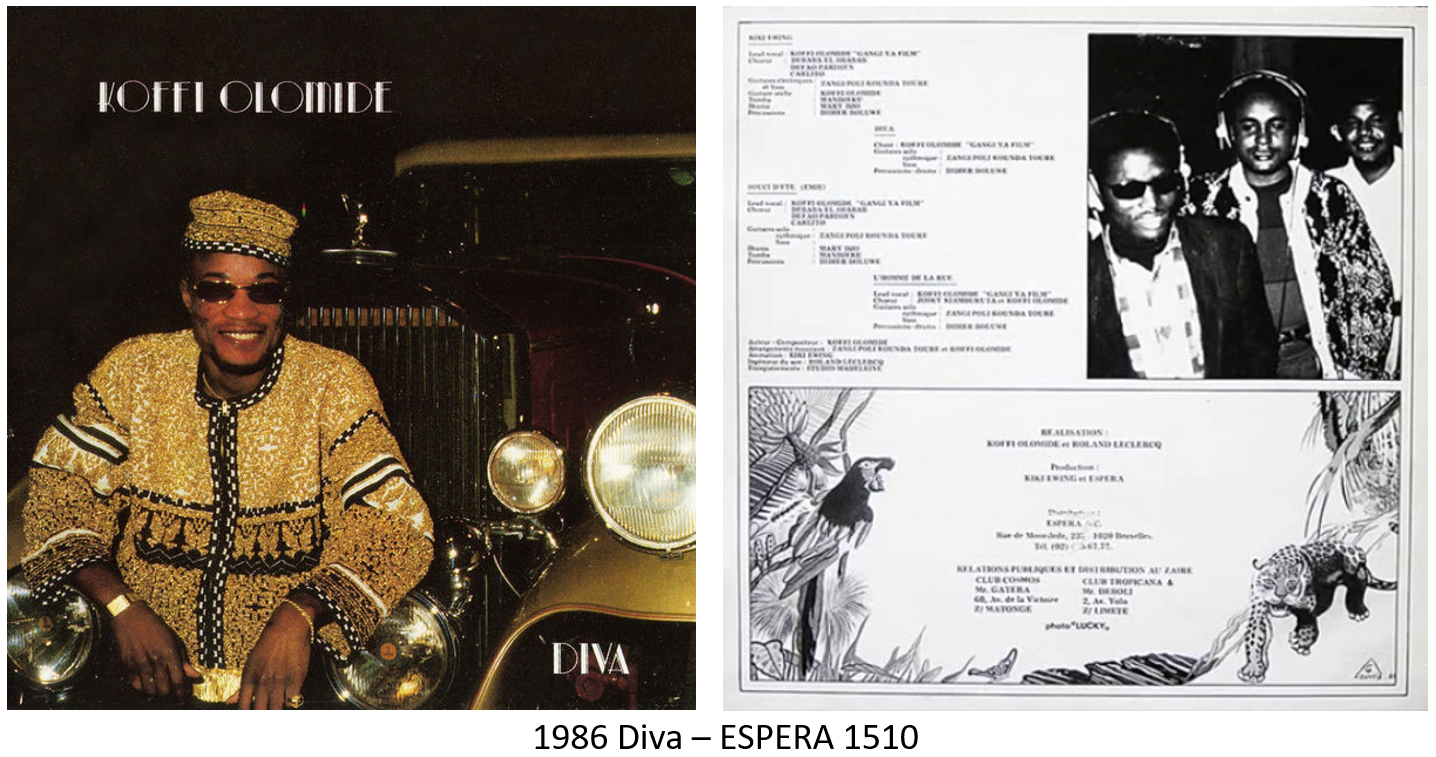
After graduation in 1980, Olomide returned to Congo and decided to become a professional musician. He cut his first solo album in Belgium with producer Roland Leclerc in 1983 and returned to Congo for two collaborations with well-known singers Fafa de Molokai and Yakini Kiesse. Olomide started his own band, Quartier Latin, in 1986 and started turning out singles and albums on a regular basis, both under his own name and as Quartier Latin. Influenced by the zouk band Kassav’, Olomide incorporated international dance music and electronics into his sound. His international success started with 1987’s hits “Kiki Ewing” and “Ngobila” released internationally on the album Diva and 1998’s Henriquet and the 1988 Congolese album Golden Star dans Stephie. They were compiled and released later as Tcha Tcho by Stern’s UK.


In 1991 Olomide took his tcha tcho beat international by signing with the French Sonodisc label. He began recording new tunes and newer versions of old material on a series of hit albums including Les Prisonniers Dorment, Pas de Faux Pas, Noblesse Oblige (1992), which went gold, Magie (1994) with Quartier Latin, and V12 (1995). In 1994 Olomide was named Best Male Artist at the African Music Awards. In 1996 he reunited with is first boss, Papa Wemba, for the collaboration  Wake Up.

In 1997 Olomide became a pop star in France and much of Europe with the success of Loi (1997) and Ultimatum (1997) recorded with his band Quartier Latin. He played the Olympia in 1998 and released the concert as Live a L’Olympia (1997). Droit de Veto (1999) another Quartier Latin album earned him his second gold album just six months after its release in France. Attentat went almost instantly gold; with Quartier Latin he headlined Bercy Stadium, the largest concert venue in Paris. The album Live a Bercy (2000) captured their high-energy show.


A world tour in 2001 took him to the US and in December of that year he dropped the double solo album Effrakata (2001) He made Affaire d’Etat (2003) with Quartier Latin shortly before Sonodisc went bankrupt. His next solo outing, the double CD Monde Arabe was released by Sonima 2004. He celebrated 20th years as an artist with a tour of Europe and Africa and the album Danger de Mort (2006) made with his band Quartier Latin.

In October 2007, he returned to the Zenith in paris and in 2008 he returned with the double album Koffi. Each of the two CDs begins with a duet, one with Youssou N’Dour and the other with Lokua Kanza. There are also several songs with Cindy Le Coeur, a young, promising Congolese artist whom Koffi Olomide took under his wing. She was also part of his line up when he returned to the Zenith in Paris in 2009. Their artistic relationship materialised in a live CD from a show given in Kinshasa in February 2010, entitled Cindy chante Koffi.


The formula worked so well that the boss of Quartier Latin continues with the CD Koffi sings Tabu Ley. In this period several choristers and dancers filed a complaint against their band leader for rape and forcible confinement. In February 2012, he was indicted in this case while his new album Abracadabra was the victim of intensive piracy even before its release. His antourage attributes this action to the collective of Combatants, opponents of the regime in Kinshasa, who perform harsh actions in Europe against artists they suspect to support the head of state. 
In August, the singer appeared in Kinshasa on charges of intentional assault on his producer. For this fact, he was sentenced to three months suspended prison sentence. 


Musically he makes a name for himself in 2013 with an extraordinary production, consisting of 4 CDs that together contain 39 songs. The album contains several duets including Cindy le Coeur, Ferre Gola and Evoloko and is entitled 13ieme Apôtre (13th Apostle). The album is released simultaneously released in France and the DRC on October 13, 2013 (10/13/13) at 1:13 pm, according to the express wish of Koffi Olomide. 


Unfortunately, in July 2016, he is once again discredited when film footage becomes public, showing how the singer hits one of his singers during a tour in Kenya. He is expelled from the country. Back in the DRC, he was imprisoned on July 26 in Kinshasa after being charged with “intentional assault and battery” a complaint having been filed by a deputy chocked by the singer’s attitude. After 4 days in detention, he was released on bail but remained prosecuted.

On August 7, he reappears on stage for the 10-year career of Fally Ipupa, a former member of the Latin Quarter. And on August 13, he performed at the Kintambo Velodrome stadium under the theme "Koffi sings freely". He took the opportunity to celebrate, among other things, his 60th birthday.  In 2017 the album Nyataquance will be released, with the song Pardon, on which the singer seems to ask the African woman forgiveness for the mistakes he made earlier.


Mid August 2019, the release of a new album is announced with the publication of the video clip Papa Ngwasuma. 


DISCOGRAPHY